
We are witnessing one of the more exciting evolutions in modern helicopter history: the race for speed. To obtain dramatic improvements – unachievable by conventional helicopters – manufacturers have been exploring innovative technologies such as tilt-rotors and compound helicopters.
Notwithstanding the majority of recent developments originated from US firms, such as the Bell Boeing V-22 Osprey, the now Leonardo AW609, Sikorsky’s X2 and its successor S-97 Raider, also in Europe the urge for speed has prompted Airbus Helicopter to experiment the X3 test bed.
Nothing compares though with what is being developed in USA under the overarching FVL joint military program and in Europe within the Clean Sky 2 Program.
The race for “Capability set 3” rotorcraft (e.g., Black Hawk and Apache replacement) is engaged by and between the three major US manufacturers and we are observing a fiery competition among two disruptive technologies. It will be the Tilt Rotor (Bell Helicopter and Lockheed Martin V280 Valor) against the Compound (Sikorsky-Boeing SB-1 Defiant).

At the end, the US Army – as well as the Marine Corps and the Air Force – will choose the technology that better fits the operational requirements (or it may be both?); OEMs will manufacture hundreds of units and the technology will become mature and ready to be fielded also in non-military operations.
Competitions for the other capability sets to complement the 1 to 5 scale are not started yet, but they already promise unthought-of developments.
Although the same need for speed is shared in Europe, the approach is fundamentally different. Through the Clean Sky 2 Program – a Public-Private Partnership between the European Commission and the industry, with a strong emphasis on SMEs – the EU leverages innovation across Europe to develop breakthrough technologies to significantly increase the environmental performances of airplanes and air transport.
The Program envisages three Innovative Aircraft Demonstrator Platforms (IADPs), from Fast Rotorcraft to Regional Aircraft and Large Passenger Aircraft.
The Fast Rotorcraft IADP consists of two separate demonstrators, the NextGenCTR tilt-rotor (Program led by Leonardo) and the LifeRCraft compound helicopter (Program led by Airbus Helicopter), aiming at delivering more speed along with range, capacity, productivity, efficiency and sustainability.
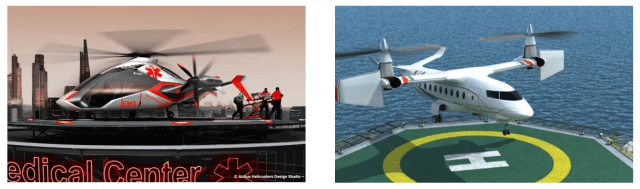
The companies involved in this Program encompass a large number of European aeronautical enterprises, to include several SMEs. It is the aim of Clean Sky 2 that the participating companies will apply the break throw technologies being developed to the next generations of aircraft, in timescales otherwise unachievable.

 MXP Aerospace LLC